


The 8-string guitar : The Project


Some history
Why use an 8-string guitar to play the classical guitar repertoire ? Well, the first reason comes with the history of the instrument. As a matter of facts, the guitar didn't always have 6 strings. A simple look at the ancestors of the guitar, during the Renaissance era for example (15th -> 17th c.), and the likes of the lutes, archlutes and the theorbo, that could have up to 10 strings, makes you realize it wasn't an obvious choice.
Even after, during the Romantic period (18th - 19th c.), actual guitars had often more strings, with non-fretted basses regularly added on top of the other strings. Famous guitarist composers from that time notoriously had guitars with more than 6 strings, like Napoléon Coste (1805-1883) and his 7-string guitar, and Johann-Kaspar Mertz (1806-1856) who owned a 10-string guitar.
Only later, at the end of the 19th century, did the luthier Antonio de Torres (1817-1892) mark the beginning of a new era of the classical guitar, with new techniques and innovations allowing the 6-string guitar to become a much more powerful and sophisticated instrument.
Issues and arrangements
The classical guitar, like any other instrument, has some technical limitations, such as speed, tone production… but there are also specific ones. In my opinion, the main issues are the range of the guitar, that is very restricted compared to other instruments, and the problem of coherent voicing. Often, guitarists struggle to play a piece following exactly what is written on the score. They will more than once have to ‘arrange’ the music so it can fit their fingers or sound in a way that the musical idea goes through.
Here, arranging can be moving a voice an octave up or down, as sometimes the voices end up on the same strings, which forces us to otherwise abandon one of them. It can also be deleting doubloons or ‘less important’ notes in a chord in order to be able to insure a technically smooth way through the melody. Sometimes, you might even notice that the composers themselves had to change the voicing to fit the guitar, and the voice line on the score will already appear with jumps of octaves (often in the bass).
This is true for many pieces of the repertoire in the past centuries, from music written originally for lute to music of the 21st century. In this project, I will focus specifically on music written by non-guitarist composers from the 20th century.
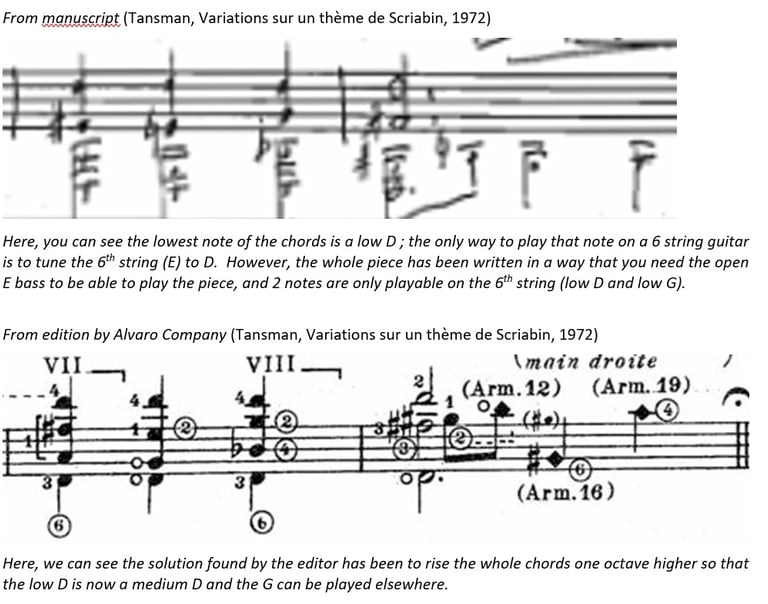
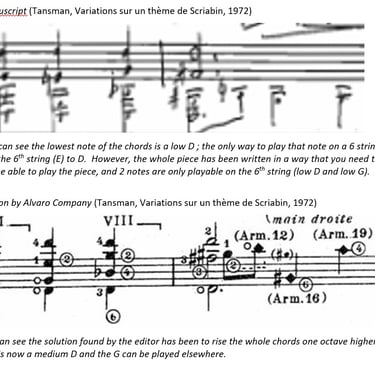
The 20th century and its repertoire
During the 20th century, a lot more composers became interested in writing for classical guitar, and especially because of the influence of Andres Segovia. Being the most famous and most demanded classical guitarist of the century, Segovia inspired and commissioned a lot of works for the classical guitar, and many of the composers he worked with couldn’t play the guitar themselves. Often, he modified the scores he received so they would fit the guitar (and his way of playing) better, and a lot of pieces dedicated to him have a ‘manuscript’ score as well as a ‘Segovia’ edition, that can occasionally show major changes from the original.
During that time, even non-guitarist composers that didn’t specifically work with Segovia started to write more and more for the guitar, resulting all in all in creating a big repertoire for classical guitar in that period. Some of those pieces also had issues and caused other guitarists, like Angelo Gilardino, to revise and suggest editions of their own. Guitarist and composer, Gilardino published many editions of pieces through the Edizioni Musicali Bèrben, and even made editions of works already edited by Segovia, (i.e. : ‘Capriccio Diabolico ; Omaggio a Paganini’ by Mario Castelnuovo-Tedesco).
In the past years, during my academic studies, I had the opportunity to play a lot of repertoire from the 20th century and, among others, works by Joaquin Rodrigo, Mario Castelnuovo-Tedesco and Alexandre Tansman, composers who worked with Andres Segovia. Their pieces were often edited, by Segovia or others, and a lot of work had to be done with my teachers determining how we could use the edited version, if the manuscript was available and if we should find a middle ground between the edition and the manuscript. Indeed, a lot of discussions exist in the guitar world regarding the validity of some editions : some people argue that the performers (Segovia, Gilardino or others) sometimes changed the scores not only because it was impossible to play but also so it sounded more in a way they personally liked. Others defend the fact that the editions offer reliable solutions to the manuscripts problems and should be played as proposed.
The modern 8-string guitar
The modern 8 string guitar I'm using in this situation is different from the romantic guitars of the 18th–19th century mentionned above (guitars with 6 to 10 strings using the old model, with less volume, power and sound…) : the modern version uses the Torres design and the new technologies, creating a much better quality of sound and volume.
Using the current design, some luthiers have started to add 2 bass strings to the guitars. The normal tune of the 6 string guitar being E-A-D-G-B-E, the added basses can be G and B, but they can really be any note you want from G to E. In my opinion, these added strings will bring more possibilities to the voicing problem I mentioned, by increasing the range of the guitar and being able to conduct voices lower. It will give room for the middle voice so it can evolve without problems, keeping the line intact. Different models of 8 string guitars exist, like the ‘Brahms’ guitar, that has an added bass string and an added treble string ; I will not look into that kind of guitars as they are barely ever used and will not fit into my research.
The research
The growth of the guitar repertoire in the last century, following the evolution of the guitar itself, is quite present in the mind of classical guitarists, but the issues that emerge are nowadays merely considered technical challenges.
My approach with the 8-string guitar will here be concentrated on those technical challenges. I am convinced that, with the help of an 8-string guitar, we can take a closer look at the manuscripts of the masterpieces of that time, and find new ways to perform those pieces in a manner that would respect the original score more. Researching new ways of approaching it hasn’t yet been documented to my knowledge, even though some guitarists do have innovative ideas, using guitars with more strings.
One of the most famous is Raphaëlla Smits, who notoriously plays on a romantic style 8-string guitar and has become a specialist of romantic music, recording several albums. We can also mention Stefan Schmidt, who recorded all of J.S. Bach’s lute works (BWV 995 -> BWV 1000) on a 10-string guitar, to get closer to the manuscripts (when available) or to a more ‘historical’ performance. I find those recordings very interesting in the light of what I’m trying to achieve here, as they used the added strings they have to play pieces in a way that is closer to the original unedited version.
I believe the relevance of my research is that, if we manage to show that some problems in the scores can be fixed in a better way than before, we will be able to make it easier for guitarists to play their repertoire and have the music make more sense where there used to be issues.
The Catalog
To show the results of my research, I have been building a catalog, listing (non-exhaustingly) non-guitarist composers of the 20th century and their works. There, I specify if the manuscripts are available, if there are editions and how big the differences are with the original. When they exist, I then analyze the original score with the 8-string guitar in mind, and try to offer solutions or interesting input that are possible with that new instrument. Files will be including those informations, and pictures of the spots where alternative solutions are suggested and added are made available along with the list of composers/works.